|
Introduction
Games for two players differ widely according to the
received wisdom on the advantage of first play. In chess,
starting is a major boost for an expert, but in shogi
(Japanese chess) that isn't true. In mathematically
analysed games, such as Nim or Gomoku, first play should
be decisive. In the mancala game Oware, a proof has been
announced that best play leads to a draw.
Here are some links to the games mentioned
Shogi
Nim
Gomoku
Mancala
Oware
Hex
In Hex, which is known to be a first-player win but for
which the winning strategy isn't understood, the
so-called 'pie method' is applied to give interesting
games. The player who starts must give the second player
the choice of changing sides after the first move. It's a
version of 'I cut, you choose'. Naturally this depends on
there being opening plays which are indifferent: only
about half as useful as the best ones.
The system for Go is to add to the second player's score
a number of points, in compensation for the first
player's starting advantage. Some mathematics of parity
lies behind that, in a well-concealed way.
How much is starting worth in Go?
The game of Go has been introduced in two previous
articles on this site ('
Behind the Rules ' and '
Sufficient but not Necessary '). Go is a game that is
scored at the end, which means that in principle we could
get a definite answer to the question, how much is it
worth to play first? With best play on both sides, the
winning margin might be, say, 8 points for the player who
starts; and therefore we should compensate the second
player by giving her or him an extra 8 points of
score.
Put that way, it doesn't sound very sensible: the game
should always be a draw, and so hardly worth playing
competitively. Of course, we are a very long way from
knowing so much about Go, except when it is played on
tiny boards (up to about 5x5 in size, where 19x19 is the
regulation grid). Tournaments everywhere use the
principle of compensating the second player. Since by
convention it is Black who starts, White is awarded a
certain number of points to add to the final score. These
extra points, called komi in Japanese, or dum if you're
in Korea which is a hotbed of the game, are now set at a
level of 6.5. The half-integer value prevents draws,
which is a big plus in itself: we know that the correct
value will be an integer, so in a sense what this tells
you is that the belief is "it's 6 or 7 but we're not sure
which".
Perhaps if you haven't played Go this sounds vague and
unsatisfactory. What lies behind this number? How could
one come up with such an estimate of the advantage of
starting? Can one even prove mathematically that the
first player has any advantage? (The answer to that one
is that "passing" is allowed, so that if there were any
reason to believe the opposite the game would never get
properly started; but that's not a scenario with much
connection to the real world.)
Most of the interesting and significant questions about
Go have answers that come in terms of its rich and varied
history in the countries of East Asia. The short answer
in this case is that in Japan, komi has been the general
system since about 50 years ago, as newspapers sponsored
more tournaments and long, specially-arranged, matches
between top players died out. At that point komi was
usually 4.5 points; the higher value 5.5 came in a
generation ago, and 6.5 was introduced in Japan only in
2002. The statistics have always pointed to an advantage
for Black, the first player, with the lower values of
komi; and professional players have over time adapted to
playing with komi by using more aggressive strategies
when starting. The process, resembling an 'arms race' in
which opening theories for Black and White are the
weapons, may not yet have reached its conclusion.
Naturally I'm not going to try here to give a compressed
version of half a century of Go opening theory. The
mathematics in this article will go back to the
fundamentals of scoring, to explain a matter that is
often discussed by players. It relates to the fact that
there are two ways of performing scoring in Go, which
give results that are almost identical - but not quite.
Firstly I want to explain why this isn't a matter of much
concern for players who take up Go for fun - which would
be almost everyone. And then I'll reveal what a little
piece of number theory has to do with the difficulty of
answering the question I'm sure is on your lips - "is
komi 6.5 now in China, too?" The correct Chinese term is
in fact tiemu.

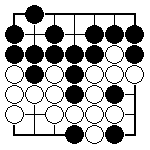
This is a typical end-position in a game, on a small 7x7
board to keep things simple. There are some of Black's
stones hopelessly cut off in White's area: three of them,
in the lower right.
The first method of scoring is called area
scoring . This is the method sketched in the
'Behind the Rules' article. There are 49 intersections on
the board, and controlling half of them would give a
target area of 25. Black's area consists of the top two
rows of seven points, six in the third row, two in the
fourth row and one in the fifth row: for a grand total of
23. Bad luck: that means White controls 26. The three
stranded stones are disregarded - in fact White could
easily have just taken them off the board right at the
end of the game. Players with any experience simply take
as read that these pieces contribute nothing to Black's
score, and their removal is part of the 'mopping-up'
talked about in 'Behind the Rules'.
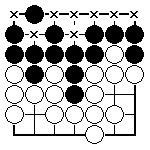
The second method of scoring is called territory
scoring . It involves smaller numbers, but two
for each player: a count of empty territory, and the
number of the opponent's stones taken. In fact in this
game Black had taken three of White's stones; and White
had taken two of Black's, to which we add the three
hopeless stones in the diagram for a total of five.

Territory refers to empty points surrounded: we see eight
points of territory, marked 'x', in this diagram,
belonging to Black. White can be seen to have ten points
of territory. Adding up, Black has 8+3 = 11 and White has
10+5 = 15. Again White wins, this time by four rather
than three.
The area method is often called 'Chinese', and the
territory method 'Japanese', because of the official
rules used in those countries. Since Taiwan uses area
counting and Korean players territory counting, it is
better to have more abstract names. What is the
relationship between these ways of scoring? Here both do
give the game to White, without even introducing any
compensation; but it isn't so clear what is going
on.
A few basic equations will help. Each player's area is
made up of empty territory plus the number of points
occupied by safe stones: say we write
Area(Black) = Territory(Black) +
Safe(Black)
and the same for White. Also each stone played by Black
will end up either as a safe stone or a captured stone
(let's leave out the possible complication of seki,
mentioned in the 'Sufficient but not Necessary' article).
So we have a further pair of equations like
Stones(Black) = Safe(Black) +
Captured(Black) .
The difference
Area(Black) - Area(White)
is the margin in the game measured by the area scoring
method. By rearranging what we have so far we can get
this:
Area(Black) - Area(White) = (Territory(Black) +
Captured(White)) - (Territory(White) + Captured(Black)) -
(Stones(Black) - Stones(White)).
What this says is that any difference between the margins
as measured by the area and territory methods is to be
attributed solely to the players having played different
numbers of stones. In a normal game Black starts and the
players don't pass until the end. Therefore the
term
Stones(Black) - Stones(White))
is expected to be 0 or 1, depending on whether Black or
White plays the final stone in the game. The small board
example above did have Black playing last, with a total
of 20 plays against White's 19 (as you can work out from
the data already given). The one-point discrepancy
(margin of three with area scoring against four with
territory scoring) is thereby explained.
In most cases this doesn't change the result of the game:
only if the final point of area taken by Black makes all
the difference. You would need to be quite skilful to
notice the effect.
There is something further, though. We will have another
equation.
Area(Black) + Area(White) = Area of the
board.
That's because the game will go on until every point is
claimed or controlled by someone: we are leaving aside
the seki positions that would impede this happening. The
size of board is always chosen odd, in order to rule out
simple imitative play of the 180 degree-rotation kind.
Therefore the board area is an odd number: and one of the
players' areas will be an even number, one odd.
In area scoring one compensates the second player by
saying that Black, the first player, needs not only to
have more area, for example 181 points out of the 361 on
a 19x19 board, but slightly in excess of that, for
example 184. If an area score split as 184/177 or better
is a win for Black, but 183/178 or worse a win for White,
how does that translate into territory terms?
The fact is that 184 - 177 = 7 while 183 - 178 = 5, and
we can't have difference 6: this is how the parity effect
of a board of odd size manifests itself. By setting 185
as the target score for Black, recently, the Chinese
authorities have in fact made a larger step than the
Japanese authorities did in changing komi from 5.5 to
6.5.
Conclusion
The two methods of scoring lead to very slightly
different games. It is hard, though, to imagine human
players strong enough to be able to exploit the
distinction: games theorists led by Professor Elwyn
Berlekamp at Berkeley have worked very hard on the issue
of who gets the last scoring point. To most players it
looks more like a random bonus to the first player. To
say that area scoring, which is more easily founded
purely mathematically speaking, is somehow better, is to
miss important aspects.
|